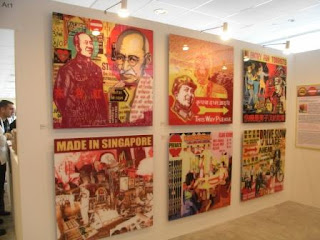
THUKRAL & TAGRA
Courtesy Bose Pacia/Nature Morte
The VIP Art Fair has announced its list of participating galleries for the opening of its inaugural edition Jan 22-30. The fair -- an acronym for “Viewing in Private” -- is the first-ever to take place exclusively online and has assembled 139 contemporary art galleries from 30 countries. Works by renowned artists such as Franz Ackermann, Francis Bacon, Damien Hirst, Anselm Kiefer, Takashi Murakami, and Jackson Pollock, will be on offer, along with hopefully exciting emerging artists, all from the comfort of their own home. The fair was co-founded by James Cohan, owner of James Cohan Gallery in New York and Shanghai and Internet entrepreneurs Jonas and Alessandra Almgren. Browsing on www.vipartfair.com will be free though you had to register, but there will be a VIP’s VIP experience for which you’ll have to pay a fee, that give you access to integrated chat and messaging system for live interaction with galleries and other benefits
© Takashi Murakami
Courtesy Blum & Poe


The VIP Art Fair will be divided into three distinct exhibition halls:
• VIP Premier: comprised of 91 leading galleries, each presenting 15 to 20 works depending on booth size—large or medium. Think White Cube, Marlborough Gallery, L&M Arts, Galerie Thaddaeus Ropac
• VIP Focus: comprised of 24 galleries, each presenting eight works by a single artist.
• VIP Emerging: comprised of 24 galleries, each presenting 10 works produced within the last two years by emerging artists.

A key aspect of the fair is that it is a live event. So, the gallery booths will be actively staffed and dealers are online for 12 to 18 hours a day to work with clients across the globe. VIP ticket holders have the ability to connect one-on-one with gallery staff through an integrated chat and messaging system. Once these conversations are initiated (and they can be seamlessly transferred to Skype or telephone, as preferred), dealers can discuss works being offered in the booth and can provide access to their back room inventory directly on the ticket holder’s computer screen. Here, works can be shared with clients discreetly through tailor-made “private rooms.”

Read More ...

0 comments

Christie's Hong Kong sale of Southeast Asian Modern & Contemporary Art realised $ 7.3 million, with 87% sold by lot and 98% sold by value. The top lot was the Walter Spies masterpiece Balinesishe Legende (Balinese Legend), setting a new record for the artist at $2.1 million. There was also strong interest in to Wounded Lion by Raden Saleh, the second top lot of the auction which sold for $852,000

The contemporary section saw global collectors responding in earnest to works from the established rock stars of the category including I Nyoman Masriadi and Handiwirman Saputra. That said, prices for Masriadi are still well below what they were in his heydays in 2007-2008, even if his top lot, Trombone, fresh from the easel, sold above its estimate.
Read More ...

0 comments

Christie's HJK jewels racked in $78.9 million - highest total ever for a jewellery auction in Asia and the largest ever at Christie's worldwide.  Leading the sale was the Perfect Pink, a rare 14.23 carat Fancy Intense Pink diamond, which sold for $23.2 million, making it the most expensive jewel ever sold in Asia. It went to an anonymous buyer. A total of 88% of the lot sold with a remarkable 94% sold by value. Burmese rubbies and Kashmir sapphire also fetched top prizes
Read More ...

0 comments

Mountain by Kim Whanki, a leading and pioneer Korean abstract artist, was the top-selling lot at today's Seoul Auction of Modern & Contemporary art, commanding $1 million after spirited bidding. Seoul Auction raised in total $4.5 million. From Point by another Korean master Lee UFan sold for $915,640.
Read More ...

0 comments


Chinese contemporary artist Zeng Fanzhi appears to be back in favor amongst collectors. His painting a Man in Melancholy sold for $1.33 million, over 6 times its estimate and was the top lot of Christie's Hong Kong Day Sales of Asian Contemporary and Chinese 20th Art. A second painting Little girl (my favorite, although I usually don't like his last "period") sold for $590,000, twice its estimate, while a third painting of his, Chairman Mao, was also amongst the top 10 lots! In total, Christie's sold $29.7 million, bringing the season total for the category to $66 million, an increase of 32% over the same sales last year. Of note was Liu Dahong's The Meeting Hall which set a new record for the artist at HK$2.78million, over 10 times its estimate. In the Chinese 20th Art Day Sale, works from Zao Wou-Ki remain among the most sought-after by collectors, with all of his works offered selling for over their high estimates. These sales bring Christie's Asian Contemporary and Chinese 20th Art grand total for the year to $133 million, giving Christie's 62% market share compared to Sotheby's.
Read More ...

0 comments

Vacheron Constantin has unveiled a one of a kind creation inspired by Marc Chagall and his monumental fresco painting adorning the ceiling of the Garnier Opera House in Paris. The timepiece features a faithful reproduction of the entire Chagall ceiling, which the artist painted in 1964. Chagall’s work transformed the ceiling of the Opera House into a vast poetic sky whirling with opera heroes, brilliant musicians, entwined lovers and legendary characters, with an overall design of a flower.  Each of the five different coloured petals depict two famous musicians surrounded by some of the works they created. The blue one features Moussorgski and Mozart, along with Boris Goudonov and The Magic Flute; the yellow depicts Tchaikovsky and Adam, with Swan Lake and Giselle; Stravinsky and Ravel shine in red with The Firebird and Daphnis et Chloé; green lends a fresh touch to Berlioz and Wagner and the love stories of Romeo and Juliet and Tristan and Isolde; while white with a touch of yellow exalts Rameau and Débussy, along with the latter’s Pelleas and Mélisande. The works of Beethoven, Gluck, Bizet and Verdi are represented in the circle of the dome surrounding the central chandelier. Dotted here and there are some of the most famous Parisian landmarks: the Eiffel Tower, the Arc of Triumph, the Place de la Concorde with its obelisk, and of course the Garnier Opera House itself. Chagall described the ceiling as “the colourful mirror of silk dresses and jewellery lighting up the shoulders of the most beautiful women in Paris.”
Read More ...

0 comments


“Potted Chrysanthemum in a Blue and White Jardiniere” by Sanyu broke the artist’s auction record at Christie's HK auction of Asian contemporary and Chinese 20th century art sale. It fetched $6.7 million, with a competition between two phone bidders pushing far beyond its presale estimate. The sale totaled $36,2 million with 84% sold by lot and 78% sold by value.  The lower than expected result was partly due to the failure to sell Cai Guo Qiang’s 32-meter wide “Search for Extraterrestrials” in Chinese ink, smoke and gunpowder on paper. A Zeng Fanzhi's Mask sold for $3.9 million more than double its pre-sale estimate, while Zeo Wou-Ki's Cathedrale et Ses Environs sold for more than twice its estimate at $2.4 million. Wang Guangyi, Zhan Wang, Mao Xuhui, Aya Takano and Tatsuo Miyajima all established new records for their works
Read More ...

0 comments

The two-day wine sales at Christie's HK totalled US$10.35 million, and was 90% sold by lot, 96% sold by value. Nearly 80% of the lots sold over the high estimate. The sale demonstrated the continued strength of the great first growth Bordeaux and indicated a new interest in large format bottles and in older vintages, Christie's said. Burgundy values were also strong, particularly for Henri Jayer and Domaine de la Romanée-Conti, and champagne prices remained bubbly, with the superlot from Krug representing the highest value ever consigned directly from the winery. This brought Christie's Hong Kong Wine sales to HK$169 million for the whole of 2010 with over 96% of all lots sold by value. Their next auction will be Mar 4-5.
Read More ...

0 comments

Forever International Auction Company Limited, Christie's trademark licensee in China, recently concluded its two-day Autumn auction series on November 24, with total sales amounting to RMB169 million ($25 million), doubling its Spring auction total. The sale of fine Chinese jades and works of art raised $13 million with 72% of the lot sold andthe top lots achieving well above their estimates. The sale of Chinese 20th century and contemporary art raised $1.45 million with 73% of the lots sold, but the sale of fine chinese paintings and calligraphy was disappointing with only 49% of the 246 lots sold, though they raised $8.45 million. Demand was strong for Qi Baishi and Zhang Daqian, whom together sold the top 5 lots.


This season marked the inaugural sales of Mou Tai, the Chinese national spirit and 92% of the 13 lots on offer sold raising $305,00. The result of the wine sales, titled Best Wines of the New Millennium, was a bit disappointing in light of the recent white gloves auctions in Hong Kong - only 66% of the lots were sold, providing that buyers prefer old vintages.
Read More ...

0 comments

Introduced in 1947, the Vulcain Cricket was the world’s first mechanical alarm wristwatch, with a sound so strident it could wake a heavy sleeper from the deepest slumber. It established Vulcain as an innovative watchmaker and soon the timepiece got endorsements that many watchmakers could only dream about today: several U.S. presidents started wearing it in public. President Harry S. Truman, who had been given one by the White House Press Photographers’ Association in 1953, often praised it and wore it regularly. His successor, President Dwight D. Eisenhower, also wore a Vulcain Cricket, and so did President Lyndon B. Johnson. The watch became known as the Presidents’ watch and was so popular that the Swiss manufacturer churned them out by the thousands and could barely meet demand. Nevertheless, like many other Swiss brands, it fell victim to the rise of Japanese quartz watches in the 1970s and by the mid-1980s, Vulcain and its Cricket had fallen into oblivion after the manufacturer stopped production. It was resurrected in 2002 by Bernard R. Fleury, the founder and chief executive of Production & Marketing Horloger, after he acquired the patent on the Cricket movement. While the Vulcain brand has struggled to regain its place in the heart of U.S. buyers, it has made some headway in Asia, having come up with new technical innovations, like a self-winding alarm movement, and it is the first alarm watch with a flying tourbillon. Now, with a new marketing campaign harking back to its former presidential endorsements, Vulcain is hoping to recover its past glory in the United States. Read the whole story in the IHT.
Read More ...

1 comments

Vacheron Constantin
The complex Japanese lacquering technique known as maki-e is often found on luxury pens, but only a few companies have applied it to watch dials. Nevertheless, this year Vacheron Constantin, Van Cleef & Arpels and Chopard have all teamed up with Japanese maki-e masters to release limited-edition watches. Maki-e, which translates as “sprinkled picture,” is a traditional multilayered lacquering method in which fine colored or precious metal dust, often silver and gold, is sprinkled to form a design or picture on a lacquer surface while it is still wet. This decorative technique uses a rare varnish-tree lacquer that acts as a protective, clear glue between each successive layer, giving the finished scene depth and perspective.

While watchmakers have been using enameling techniques like cloisonné and champlevé on their dials to great effect for decades, they have largely stayed clear of lacquer until fairly recently. This year, Chopard introduced its first “L.U.C. XP Urushi” collection. Van Cleef also released a limited edition of eight maki-e watches, “Midnight Extraordinary Japanese Lacquer,” inspired by traditional Japanese landscapes. Read the whole story in the IHT.
Read More ...

0 comments

Last year proved to be hard on small independent watch brands, as retailers generally stopped buying on consignment to lower their inventory costs, requiring small watchmakers to wait until a watch was sold to be paid. Max Büsser, founder and chief executive of the independent watchmaker MB&F, found himself traveling around the world to keep sales ticking. This year, things have turned around. Mr. Büsser is still traveling as much as before, but he does not have to deliver the hard sell any more. By introducing four new models in one year, instead of just one as before, increasing the number of retailers he deals with from 12 to 19, and still keeping the overall number of watches the company releases unchanged, MB&F has put the pressure back on retailers. Next year, Mr Büsser plans to increase production to between 165 and 175 pieces, and to open the watchmaker’s first-ever concept store in September with a local partner in Beijing. “One of my dreams will be coming true: that our machines will be sold in an art gallery, because let’s face it, they’re closer to kinetic art than to what is known today as a watch,” he said. “So we are opening a gallery that will present our pieces along with traditional kinetic art. Right now, I’m scouting around the world for artists working in this very rare form of art.” Read the full story in the IHT.
Read More ...

0 comments

Bonhams Hong Kong achieves a white glove auction with the Part II of the world’s finest collection of important Chinese snuff bottles, the Mary and George Bloch Collection. The sale raised HK$54.8 million, more than double the presale estimates with every one of the 155 rare bottles sold. A good number of the lots sold for twice to four times their estimate.

A new world record for a porcelain snuff bottle was reached when Lot 121 sold for a staggering HK$8.38 million, four times its pre-sale estimate.Commissioned by the Qianlong emperor and enamelled in the palace workshops of the Imperial Palace between 1736 and 1760, this snuff bottle, decorated with ‘double-gourds’, symbolic of long life, is identical to another rare example still preserved in the Forbidden City Palace Museum.
The highest price of the sale, and a new world record for a glass snuff bottle was achieved by Lot 152, a 'famille-rose' enamelled gold-ground glass 'lotus' snuff bottle, which sold for HK$9.05 million, almost four times its presale estimate . The snuff bottle was commissioned by the Qianlong emperor (1736-95), and decorated with lotus flowers against a rich golden ground, and incised on the base with the Imperial mark.


The same real-estate Chinese tycoon who broke the world record when he paid HK$9.28 million for a snuff bottle on his first day of collecting them at the Part I of the sale held in May was again a big buyer his time around. Part III of the Snuff Bottles from the Mary and George Bloch Collection will take centre stage at the Bonhams Spring 2011 Auctions to be held in May 2011
Read More ...

0 comments

Southeast Asian artists have often found inspiration in the turbulent socio-political environments of their nascent democracies, and the tense political environment in Thailand in recent years has provided plenty of fodder. Natee Utarit is best known for his work questioning the nature of images, in particular photographs, through the medium of painting. But in recent years he, too, has felt the need to comment in subtle ways on his country’s complex political and social landscape.. "I think the recent political context has influenced many artists in Thailand. I cannot deny, it is influencing me,” the 40-year-old artist said last month. “But my work is not really about politics, it’s more about the social changes.”


The clear evolution in Mr. Utarit’s work is now on display in a mid-career retrospective, “Natee Utarit: After Painting,” at the Singapore Art Museum through Feb 20. Mr. Utarit started his career painting abstract works, but he quickly moved toward a representational approach to explore Western established modes of painting, such as figuration, landscape and still life. Behind many of the works are references to historical works by European masters such as Caravaggio, Courbet and Titian. In his “Pictorial Statement” series in 2000, Mr. Utarit superimposed monochromatic paintings of Thai landscape photographs onto exact reproductions of paintings by the Old Masters, establishing a dialogue between the classical masterpieces and photography. His 2005 series “Last Description of the Old Romantic,” features floral still lifes, copied from classical paintings, which he stained to dim their splendor as a reflection on the notion of beauty.

The year 2007 marked a shift in the artist’s practice, as he started using children’s toys to comment on Thai society. In the 2009 painting “Tales of Yesterday, Today and Tomorrow,” he features an arrangement of toys, loosely referencing the complex and enigmatic composition of “Las Meninas,” by Diego Velázquez. The Spanish court characters of Velázquez’s 1656 painting have been replaced with characters well-known in the Thai context, such as the politician or the soldier, Mr. Utarit explained. To reinforce the meaning of the painting, he uses colors that have symbolic meaning for the Thais, such as blue and yellow, which are associated with the king and royalty.

In “The Prince,” painted in 2008, the year former prime minister Thaksin Shinawatra was charged with corruption, Mr. Utarit shows a small toy prince facing the Thai flag, yet with his feet pointing in opposite directions, thereby betraying his actual stance. Next to the toy are two yellow rubber ducks, a visual pun for lame-duck politicians.

Read the whole story in IHT.
Read More ...

0 comments

The Gwangju Biennale Foundation has appointed Seung H-Sang, a Korean architec,t and Ai Weiwei, as co-directors of the 4th Gwangju Design Biennale. The 4th Gwangju Design Biennale will be held at the Biennale Exhibition Hall and throughout the metropolitan city of Gwangju from September 2nd to October 23rd 2011
Read More ...

0 comments

Following on the success of its Hong Kong sale in October in which Marc Chagall’s Bestiaire et Musique set a record as the most expensive painting by a Western Modern artist ever sold in Asia, Seoul Auction will hold another sale of impressionists and modern master in Hong Kong on November 29. The jewel of this auction will be Renoir’s Baigneuse s’arrangeant les cheveux, painted circa 1890, around the time when he married Aline Charigot and changed direction in his technique, returning to more fluid brushwork and thinly brushed colour to dissolve his outlines. This painting was painted at the beginning of Renoir’s so-called “Periode Nacrée” (1890-1897) in which delicacy, form, colour, light and pleasure combine to create a painting of exquisite beauty and sensuality.


Another highlight of the sale will be Bouquet de Fleurs by Marc Chagall, circa 1937. It’s a typical example of Chagall’s imaginative and very personal style. Strong colours combined with more subdued hues portray the world with a dreamlike, non-realistic simplicity. The painting celebrates love and portrays the artist and his muse Bella, whom he had married in 1915, in a rapturous embrace amidst a rich bouquet of flowers.

Read More ...

0 comments

 There was a nice buzz at the opening of the Affordable Art Fair, with lots of vibrant, fresh works, many by young Asian artists. Of course, it was also a bit of a mix bag, with pretty decorative paintings mixed with paintings with more artistic value... But with prices as low as a couple of thousand hundred dollars, there were some opportunities for newbie collectors to get something interesting.  Here are some of my favorite works

:

The fair goes on until Sunday. Go a check it out! Lots of good photography...
Read More ...

0 comments


For Chang Yang-Fa, toys are not playthings. His search for the first series of Tamagotchi, the small, handheld digital pet that first appeared in Japan in 1996, is serious business. Mr. Chang, 61, already has in his collection almost the entire second series, but he is still missing the first-generation Tamagotchi, which were made in Japan. These toys are all kept sealed in their original boxes, like many of the other 100,000 toys that he has amassed over the past 30 years. Mr. Chang is a well-known Singaporean toy collector and owner of the Moment of Imagination & Nostalgia with Toys (MINT) Museum of Toys in Singapore. Over the years, he has collected a large range of Asian vintage toys, ranging from Chinese Door of Hope dolls to Japanese rockets and his most valuable item, an 8th Man Robot worth about $30,000.  Japanese brands dominated worldwide toy-making activity in the 1950s and 1960s, with brightly colored tin toys that captured the imaginations of children around the world and coincided with space fever in the United States, which was a major export market. But by the late 1960s to mid-1970s, toys made in Japan had become expensive and the center of world toy manufacturing moved to Hong Kong, which dominated with mass-produced plastic toys, especially miniature cars for the British market. The early plastic toys from Hong Kong are highly collectible because they were made of hard plastic and were very brittle, breaking easily, and therefore those still intact are more rare. Read the full story in the IHT.

Read More ...

0 comments

Once banned by Mao Zedong as a bourgeois activity, stamp collecting has become increasingly popular in China in recent years. While early collectors were from Hong Kong, Taiwan, and the international Chinese diaspora, some important Mainland Chinese collectors are today “repatriating” stamps, in the same way that others are bringing back Chinese artworks.


A franked version of a 1968 stamp that Robert Schneider, a principal with the auctioneer InterAsia Auctions in Hong Kong, called “the most iconic stamp of the People’s Republic of China,” sold at auction in August for 345,000 Hong Kong dollars, or about $44,500.

The stamp, titled “The Whole Country is Red,” depicts a group of workers holding Mao’s “Little Red Book,’ with a red map of China in the background. It was pulled from circulation on the day it was issued, however, officially because the map omitted the Xisha and Nansha Islands, although probably a more important omission was Taiwan. Some of the stamps had been sold before the order to pull them came.  Read the whole story in the IHT.
Read More ...

0 comments


Beyond Fashion is a new exhibition that tries to make the crossover between fashion and art. Eight fashion designers have been paired with eight young Chinese artists to complete fashion designs based on fur and inspired by the art works. The link between art and fashion has been quite tight in recent years in China and this one new way of exploring the links.


Read More ...

0 comments


Young Chinese artist Yi Zhou is showing at Contrasts Gallery in Shanghai ‘Earbridge and The Greatness’, an exhibition of two 3-D video animations, ink brush drawings and sculpture. She made the short films The Ear in 2009 and The Greatness, a sequel to The Ear in 2010. The former stars Pharrell Williams, the recording artist and producer, in a story inspired by Nikolai Gogol’s short story The Nose, and features music by Ennio Morricone and costumes by Rick Owens and BBC Icecream. The Greatness is a reinterpretation of Dante’s Divine Comedy and explores the boundaries between reality and dreams, imagination and madness, and life and death.
Read More ...

0 comments

“Made in Singapore” is becoming a more common tagline for computer-generated animation. While this industry in Singapore is less than 10 years old and still very much in its infancy, it has turned an important corner in the past couple years, executives and analysts say. Christopher Chia, who until two weeks ago was chief executive of the Media Development Authority in Singapore, said he saw local production moving up the value chain. “In the early years, our industry could be characterized as a fee-for-service industry,” said Mr. Chia, who is now a senior adviser to the Ministry of Information, Communications and the Arts. “Somebody out there would commission a part of a show and companies here would execute.” “But increasingly, our companies are either co-owning or owning the intellectual properties,” he said. “At the same time, they’re working with the bigger boys around the world to co-produce or co-market the content.” That is the case with Dream Defenders, developed and produced by Tiny Island Productions of Singapore and introduced in October at the Mipcom trade show in Cannes. When completed, the 26-episode show will be the first three-dimensional series from Singapore. Another local studio, Sparky Animation, signed a contract with the Jim Henson Co., creator of the Muppets, to co-produce a second season of the award-winning children’s series Dinosaur Train, which is animated and computer-generated. It also participated in the first series. Meanwhile, August Media Holdings, which is based in Singapore, recently signed a $60 million deal with the U.S. media company Classic Media to develop and jointly produce 10 new shows for television. They will be based on children’s classics from Classic Media’s catalog, which includes “George of the Jungle” and “Mister Magoo.”

August Media was founded in March by the industry veteran Jyotirmoy Saha, who used to be co-head of Sparky Animations. Three months ago, the company acquired the Scottish children’s content producer Red Kite Animations, founded in 1997 by Ken Anderson. Red Kite is behind The Secret Life of Benjamin Bear, Dennis and Gnasher, 64 Zoo Lane, and The Imp. “The real business is in developing and owning intellectual property, with media products that can move across different platforms,” Mr. Saha said. “As a company we’re trying to build this business in a complete 360-degree manner,” he added. “We acquired Red Kite because we wanted to move quickly and that was a good way to jump-start our kids’ content business.” Mr. Saha said the company was in negotiations to acquire a couple of distribution companies in Europe that would help August Media Holdings “control the monetization of our own content and that of our partners.”

August Media will be one of the first tenants of Mediapolis, a 19-hectare, or 47-acre, high-technology media park, when the first building opens there in December. The park will take as long as 10 years to be fully developed but is envisaged as a self-contained media ecosystem, with soundstages, digital production and broadcast facilities, and media schools. Read the whole story in the IHT.
Read More ...

0 comments

Pink Man series

Manit

Southeast Asian artists have often found inspiration in the turbulent socio-political environments politics of their nascent democracies, and with the latest development in Thailand, there is plenty to inspire artists. ‘‘Manit Sriwanichpoom: Phenomena and Prophecies,’’ just closed at sam at 8Q but will be moving to Srinakharinwirot University next April. Manit is best known for his iconic Pink Man Series of photographs, in which he has been commenting on Thai people’s rising consumerism, but over the recent years he's increasingly provided commentaries on the complex political landscape.  Manit’s ongoing Pink Man series started in 1997. It was initially conceived with a poet friend, Sompong Thawee, as a video and photo documentation of three ‘‘hit-and-run’’ performances in the streets of Bangkok, but has since taken on a life of its own. Dressed in the same garish pink silk costume, and often, pushing a pink shopping cart, the plump Sompong appears emotionless, whether in Balinese rice fields or European streets, as Manit comments on rampant consumerism. He said he chose pink ‘‘because as a child I grew up associating it with bad taste.’

 Horror in Pink No.1
In the Horror in Pink series (2001), he was even more politically aware, superimposing the image of his Pink Man on archival newspaper photographs taken during the bloody repression of a 1970s student uprising against a military regime. In the powerful Horror in Pink No.1, Manit has the Pink Man smiling as if satisfied despite appearing in an Associated Press photograph by Neal Ulevich, showing a man smashing a folded chair on the head of a student hung in a lynching while the crowd looks on impassively. In the Pink, White & Blue series (2005), the Pink Man wraps himself in the Thai flag, a comment on the rise of nationalism in his country, while in his latest series, Pink Man Opera (2009), he positions his character amid Thai classical dancers while exploring Thailand’s the recent political unrest through scenic recreations of various Thai proverbs. One such example is the proverb ‘‘Do not export family secrets; do not import trouble from outside.’’ ‘‘That one is based on what Thaksin [Shinawatra] has been doing since he was ousted by the coup. He’s been trying to get U.N. intervening in Thai politics,’’ the artist said.
Bloodless War No. 3 
Not all of Mr. Manit’s series include the Pink Man. His Bloodless War series (1997), transports iconic photographs from the Vietnam into a Thai context. Bloodless War No.3 uses the iconic Vietnam war photograph ‘‘napalm girl’’ taken by Nick Ut, but Manit’s characters are dressed as office workers carrying luxury-brand shopping bags.
Read More ...

0 comments

A piece of China’s Imperial history – a seal personally commissioned and used by the Qianlong Emperor (1711-1799) – sold for £2,708,000 at Bonhams. The perfect four centimetre square jade seal bearing the inscription `Zi Qiang Bu Xi’, (‘Self-Strengthening Never Ceases’) is closely linked to the Emperor’s 80th birthday celebration which coincided with the 55th year of his reign and is an iconic reminder of China’s golden age. Apparently no fewer than five curators from the Palace Museum in the Forbidden City, turned out to view it, while the seal was being shown in China. The buyer is from Beijing, but chose to remain anonymous.
Read More ...

0 comments

Sheraton Incheon Hotel
After years of benign neglect, the South Korean government is giving its tourism sector a bit of attention. Last year, South Korea started a campaign to attract 10 million foreign tourists annually by 2012 and increase the nation’s tourism revenue to $10 billion. The new goal is exciting hotel operators, who have long relied on business travelers to fill their rooms. Ho Kwon Ping, the founder and executive chairman of the luxury hotel group Banyan Tree, opened his first resort in Seoul in June, the Banyan Tree Club & Spa Seoul. “The Korean inbound tourism hasn’t really been developed. It’s largely a domestic market, with some Japanese and Northeast Asians; that’s the main market for us right now,” Mr. Ho said. “But Korea remains a place we’re very interested in because the Korean government is now very much promoting tourism and the areas of potential interest in Korea are many.” The government campaign may be bearing fruit. In 2009, 7.81 million foreigners visited the country. During 2010, inbound foreign tourists are expected to exceed the government target of 8.5 million. Still, this figure compares poorly with those for places like Singapore, where tourists numbered 9.7 million in 2009 and are forecast by the Singapore Tourism Board to reach between 11.5 and 12.5 million this year, after the opening of two resorts containing casinos. As South Korea has been preparing to receive more than 10,000 visitors for the summit meeting in Seoul of the Group of 20 leading industrialized and emerging economies, the country’s hospitality industry has been hard at work. In recent months, rooms at top hotels have been remodeled and menus reinvented to highlight the best of Korean cuisine. The event has been viewed as an excellent opportunity to showcase Korean culture. Despite South Korea’s location, mature economy and diverse natural attractions, the country’s tourism industry remains relatively small. But many international hotel operators have been encouraged by the government’s recent push to increase tourist arrivals, and are now hoping to open new properties in a market where they see great potential. Read the whole IHT story here.
Read More ...

0 comments

An 19th century roiro lacquer four-case inro by Shibata Zeshin has made the world record price at Bonhams for on inro in an international sale, selling for £162,000 in Part 1 of the Edward Wrangham collection, one of Europe’s most important and comprehensive private collections of Japanese Gentleman’s accessories. The overall sale raised £2million with 94% of lots sold by value. Many of the coveted inro and netsuke sold for over ten times their pre-sale estimates to major international collectors, including some from the USA and Japan, who were all vying for the collection. Four out of the top ten lots comprised works by Shibata Zeshin, one of the most famous painters and lacquerers of the Meijii Period. A small lacquered fubako (document box and cover) skilfully rendered in a variety of textures sold for £74,400, over ten times the pre-sale estimate . A rare grey and silver lacquer and kiri-wood four-case inro depicting a crescent moon amongst swirling clouds, sold for £66,000 against the pre-sale estimate of £2,500 – 3,000. The final work by Zeshin to be included in the top ten lots was a large single-case inro and kozuka (a handle that holds a small blade) that sold for £38,400.
Read More ...

0 comments

A rare Yuan Dynasty Blue and White 'Peony' Jar, Guan sold for the exceptional sum of $4.1 million at Sotheby's London  more than six times pre-sale expectations.The ‘Peony’ Jar saw competition from four bidders and finally sold to an anonymous buyer on the telephone.In shape, design and painting style, the jar is an archetypal example of the 14th century blue and white porcelain, and represents the final stage of the gradual alteration in proportions of the shape known as guan. The neck is more distinctive, the shoulders broader and the body expanded to make the vessel appear stable and balanced. The dramatic swelling of the body –with the widest part just above the centre – contributes to the powerful profile of this guan shape, and the Yuan guan presented a new aesthetic image with its striking blue and white decorative scheme. The painting on the jar encompasses the most characteristic elements of Yuan porcelain design – the peony scroll, lotus scroll, waves, classic scroll and petal-panels or lappets.
Read More ...

0 comments

Affordable art sounds like a misnomer nowadays, with the media regularly reporting on stories of the soaring prices of Asian art at auction houses. One might assume that buying a work of art from this part of the world, even if it’s created by a young artist, has become a pursuit now only restricted to the affluent. Defying that perception is the inaugural Affordable Art Fair Singapore. Promoting the mindset that you don’t need to spend a fortune or be an expert to appreciate or buy beautiful artworks, the prices for all the pieces displayed are guaranteed to be under US$7,600. “A lot of people feel intimidated going into a gallery, especially when prices are not up on the walls. Here all the prices are next to the artworks and we ask galleries to price 75 per cent of their works under US$5,701,” explains Camilla Hewitson, director of the fair, adding that their aim is to reach out to a new audience: “People – who for whatever reason – have a mental barrier to buying art works. It could be because of a lack of confidence or a perceived lack of knowledge.”
While the idea might be ingenious, it is not new. The fair is based on the concept launched in 1999 by gallery owner Will Ramsay in London, which soon gained popularity. Similar annual fairs have since sprung up in Bristol in the UK, and in Amsterdam, Paris, Brussels, New York, Sydney, and Melbourne. The success of these fairs is built on “dispelling the myth” that collecting art is only for the rich, explains Hewitson. The AAF Singapore will showcase paintings, original prints, photography and sculptures, and is set to be a highly promising affair with 60 galleries participating out of which 50 are international ones. A few like the Korean Jay Gallery have already participated in fairs of this kind in other countries around the world.  It runs 19-21 November at the F1 Pit Building, Marina South. Read full story in Fah Thai this month

Read More ...

0 comments

Salvatore Ferragamo has launched “The Merlion Tie” to celebrate its presence in Singapore. Its main motif is oviously the Merlion, flanked by the Vanda Miss Joaquim and the Traveler’s Palm. The half lion, half fish is a pure invention of the Singapore Tourism Board, which was looking for a marketing icon in the 1960s. It was created by sculptor, Lim Nang Seng, and while many consider it tacky it has become a symbol of the city-state, with tourists often making the trip to its location on the Bay to take photos. The animal symbolises the legend of the rediscovery of Singapura, as recorded in the "Malay Annals". In ancient times, Singapore was known as Temasek, a Javanese word for sea. In the 11th century A.D, Prince Sang Nila Utama of the Sri Vijaya Empire rediscovered the island. When the Prince first landed on Singapore's shores, he sighted a mystical beast which he later learnt was a lion. The Prince then decided to name the island "Singapura" which in Sanskrit means Lion (Singa) City (Pura).
Read More ...

0 comments

Song Wei, a young Chinese artist from Sichuan, has been giving his take on the Westernization of Chinese culture, using a cute little bear made of blue and white porcelain and tattoed with Chinese motifs and patterns, such as dragons, florals and lefts. In his latest works at an exhibition starting Nov 12 at Jasmine gallery, the bear has got himself a little rabbit friend.


Read More ...

0 comments